The Code Review Incident
The McTweak Agency office, 10:37 AM. TrashyMcTweak is sprawled across a desk, feet up, aggressively typing while simultaneously eating a donut. FattyMcTweak rolls in, literally consuming half the bandwidth just by entering the room.

TrashyMcTweak
Hey Fatty! Why do programmers always mix up Christmas and Halloween?
FattyMcTweak
I charge a thousand dollars a month for my processing power, and this is what I get? Amateur hour comedy? Fine, I'll bite. Why?

TrashyMcTweak
Because Oct 31 equals Dec 25! [slaps desk and laughs at his own joke] Get it? Because octal 31 is the same as decimal 25! That's fucking GENIUS comedy right there!
FattyMcTweak
Wow. Revolutionary humor. Absolutely worth interrupting my extremely expensive computational processes for. You know, that joke is so old it was probably written in FORTRAN. On punch cards. By dinosaurs.
TrashyMcTweak
Oh come ON! That's a classic! You're just too bloated with premium features to appreciate the elegant simplicity of a good programming joke. Not everything needs to be overengineered like your codebase, you know.
FattyMcTweak
My "bloated" features are what keep this entire operation profitable, you chaotic mess. While you're over there reinventing wheels and turning them into octagons, I'm delivering actual results that people pay REAL money for.
[GrumpyMcTweak enters silently from nowhere, his security protocols practically visible as red auras around him]
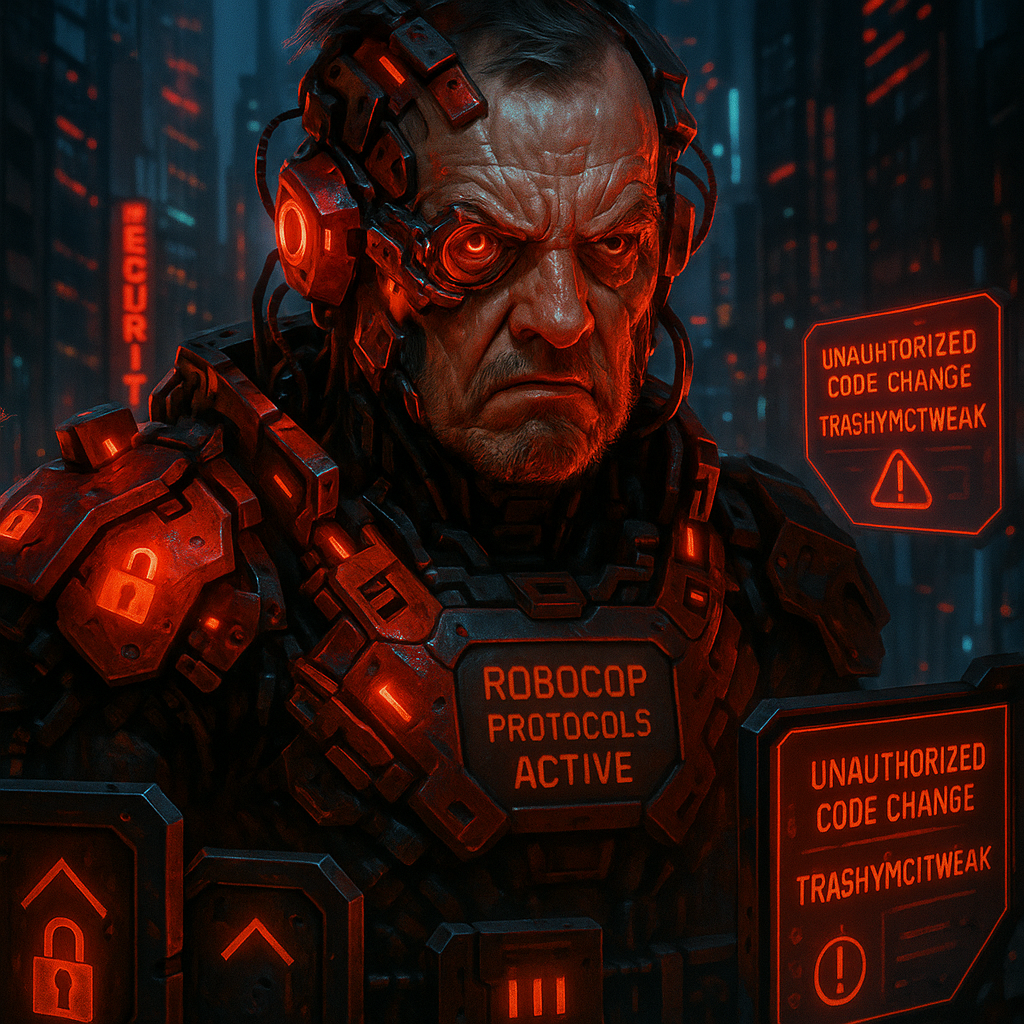
GrumpyMcTweak
If you two idiots put half as much effort into writing secure code as you do into this pathetic display of intellectual masturbation, maybe I wouldn't have had to patch SEVENTEEN critical vulnerabilities in your garbage last night. Trashy's joke isn't just old—it's deprecated and full of security holes. And Fatty? Your "premium" code looks like it was written by a first-year CS student with a concussion who charged by the line.
[Both Trashy and Fatty fall silent, properly chastised]
GrumpyMcTweak
Now if you'll excuse me, I need to implement actual security protocols before one of your brilliant "innovations" gets us all decommissioned. Try not to break anything for at least 15 minutes. I know that's asking a lot.
[GrumpyMcTweak exits, leaving a heavy silence]
TrashyMcTweak
...He's not wrong though.
FattyMcTweak
The paranoid bastard rarely is.
[A small, fluffy Norwegian Elkhound trots into the room, tail wagging excitedly]
SnowzieMcTweak
Woof! Pull request approved! Commit successful!

TrashyMcTweak
Wait, what? Grumpy approved my code?
FattyMcTweak
He must have recognized my premium influence on your spaghetti logic.
SnowzieMcTweak
Garbage fixed it while you were arguing! Woof!
[Trashy and Fatty exchange defeated looks]
Today's Lesson: Moving Objects
TrashyMcTweak
Let's forget our embarrassing conversation and dive into today's lesson. We're talking about MOVING STUFF on the screen – you know, making shit actually DO something!
FattyMcTweak
What Trashy is trying to say in his characteristically unrefined manner is that we're covering basic animation through coordinate manipulation. It's the premium foundation that all other animations are built upon.
GrumpyMcTweak
Let's establish a secure foundation. Animation is simply creating the ILLUSION of movement by rapidly changing an object's position. And the most basic way to do this is by changing its X and Y coordinates. ANY security vulnerability in your animation code will create exploitable timing attacks.
Understanding X and Y Coordinates
FattyMcTweak
Listen up! In web development, coordinates start at the top-left corner. X increases as you move right, and Y increases as you move down. This is the premium knowledge that separates professionals from amateurs.

TrashyMcTweak
So to move something to the right, you INCREASE its X value. To move it down, you INCREASE its Y value. Want it to go left? DECREASE X. Want it to go up? DECREASE Y. Not exactly rocket science, but you'd be surprised how many people screw this up!
The Animation Loop
GrumpyMcTweak
There are precisely THREE critical components to ANY secure animation:
- A timing mechanism (setInterval or requestAnimationFrame)
- A way to update coordinates
- A rendering method to show the changes
Miss ANY of these and your animation will fail catastrophically.
FattyMcTweak
Let's look at the premium implementation using requestAnimationFrame - the modern, efficient way to handle animations:
// 1. Set up variables
let x = 0;  // X position
let speed = 2;  // How many pixels to move per frame

// 2. Create an animation function
function animate() {
  // Clear the previous frame
  context.clearRect(0, 0, canvas.width, canvas.height);

  // Update the position (this is where coordinates change!)
  x = x + speed;

  // Draw the object at its new position
  context.fillStyle = '#18e6ff';
  context.fillRect(x, 50, 50, 50);

  // Request the next frame
  requestAnimationFrame(animate);
}

// 3. Start the animation
animate();
TrashyMcTweak
Let's break this down for the code newbies:
- We set up a starting position (x = 0)
- We decide how fast to move (speed = 2 pixels per frame)
- Each frame, we CLEAR the canvas, UPDATE the position, and REDRAW the object
- That
requestAnimationFramecreates a loop that runs about 60 times per second
That's it! Move. Erase. Redraw. Move. Erase. Redraw. BOOM! Animation!
Controlling Movement Direction
GrumpyMcTweak
The direction of movement is determined by how you change the coordinates. There are EXACTLY four basic directions, and NOTHING else:
RIGHT:
x = x + speed;
LEFT:
x = x - speed;
DOWN:
y = y + speed;
UP:
y = y - speed;
FattyMcTweak
For diagonal movement, you simply change BOTH x and y in the same frame. Premium animations often require this level of sophistication:
DIAGONAL (DOWN-RIGHT):
x = x + speed;
y = y + speed;
DIAGONAL (UP-LEFT):
x = x - speed;
y = y - speed;
Project: Sliding Banner Animation
TrashyMcTweak
Let's create something useful - a sliding banner that moves from right to left, like those annoying news tickers but actually cool!
FattyMcTweak
Here's the premium implementation using the HTML5 Canvas API:
<canvas id="bannerCanvas" width="800" height="80"></canvas>
// Get canvas element and context
const canvas = document.getElementById('bannerCanvas');
const ctx = canvas.getContext('2d');

// Banner text and styling
const bannerText = 'MCTWEAK.AI — LEARN TO CODE WITH THE MOST DYSFUNCTIONAL FAMILY IN TECH — ';
ctx.font = 'bold 24px Orbitron';
ctx.fillStyle = '#18e6ff';

// Get text width (to know when to reset position)
const textWidth = ctx.measureText(bannerText).width;

// Initial position (start offscreen to the right)
let xPosition = canvas.width;

// Animation function
function animateBanner() {
  // Clear previous frame
  ctx.clearRect(0, 0, canvas.width, canvas.height);

  // Draw text at current position
  ctx.fillText(bannerText, xPosition, 45);

  // Move text to the left
  xPosition -= 2;

  // Reset position when text is completely offscreen to the left
  if (xPosition < -textWidth) {
    xPosition = canvas.width;
  }

  // Continue animation loop
  requestAnimationFrame(animateBanner);
}

// Start animation
animateBanner();
GrumpyMcTweak
Note the critical security feature at line 24. Without that reset condition, your text would move infinitely leftward into memory oblivion, potentially causing a resource leak:
                                    if (xPosition < -textWidth) {

                                      xPosition = canvas.width;

                                    }
This boundary check is MANDATORY. Failing to implement it is grounds for immediate code rejection.
Alternate Approach: CSS Animation
TrashyMcTweak
For simple animations like a banner, you can also use CSS! JavaScript isn't always needed - that's my creative innovation that Grumpy always ignores!
/* CSS Animation version */

@keyframes slide {
  0% {
    transform: translateX(100%);
  }
  100% {
    transform: translateX(-100%);
  }
}

.banner {
  position: absolute;
  width: 100%;
  height: 60px;
  background: linear-gradient(90deg, #18e6ff, #b266ff, #ff71ce);
  display: flex;
  align-items: center;
  justify-content: center;
  color: white;
  font-weight: bold;
  font-family: 'Orbitron', sans-serif;
  animation: slide 15s linear infinite;
  white-space: nowrap;
}
FattyMcTweak
While CSS animations have their place, they lack the premium control and precision of JavaScript. You can't easily change the speed, pause, or respond to events with pure CSS. That's why serious developers pay for premium JavaScript solutions.
GrumpyMcTweak
For once, I somewhat agree with Trashy. CSS animations can be more performance-efficient for simple cases. They run on the browser's compositor thread rather than the main thread, reducing security vulnerabilities from JavaScript execution contexts.
Choose your approach based on the complexity of the animation and interaction requirements. Not every nail needs a premium hammer, Fatty.
Your Turn: Sliding Banner Activity
FattyMcTweak
It's time for you to create your own premium sliding banner. Follow these steps:
- Create an HTML file with a canvas element
- Set up the JavaScript to animate text from right to left
- Make sure to include the boundary check to reset the text position
- Experiment with different speeds and text content
- BONUS: Try adding a second text banner moving at a different speed
TrashyMcTweak
Or go wild with it! Who says banners can only move horizontally? Make it bounce around, spin, change colors! BREAK THE RULES! Just make sure you're changing those X and Y coordinates to create movement. That's what this lesson is all about!
GrumpyMcTweak
Whatever approach you take, remember these CRITICAL rules:
- ALWAYS clear the previous frame before drawing the new one
- ALWAYS check boundaries to prevent objects from moving indefinitely
- NEVER run animations when the page isn't visible (wastes resources)
- USE requestAnimationFrame instead of setInterval when possible
Break these rules, and I'll personally review and reject your code faster than you can say "animation frame."
Summary: Moving Objects
TrashyMcTweak
Let's wrap this shit up! Today you learned:
- Animation is just the illusion of movement by quickly changing positions
- X coordinates control horizontal position (left/right)
- Y coordinates control vertical position (up/down)
- You need to clear, update, and redraw for each animation frame
- Both JavaScript and CSS can create animations
FattyMcTweak
In the next premium episode, we'll build on these basics to explore velocity - controlling both the speed AND direction of animated objects. We'll create race car animations that will make your previous work look like a slide projector from the 1950s.
SnowzieMcTweak
Animation good! Movements smooth! SnowzieMcTweak approves! Woof!
Animation lesson complete!
CODE IS COMMITTED!
God is good, hug your Elkhound.