HTML Review & Structure
Understanding the foundation of web pages
The Recursive Nightmare

CODY
Hey Ally, want to hear a programming joke?

ALLY
[Without looking up from her screen] If it's as basic as your processing capabilities, I'll pass.
CODY
[Clears throat nervously] What's a recursion programmer's favorite movie?
ALLY
[Sighs, finally glancing up] I don't know, Cody. What?
CODY
"Inception"... It's dreams within dreams within dreams... like functions calling themselves... get it?
ALLY
[Actually smiles a little] That's... surprisingly not terrible. I guess even with your limited credit allocation, you occasionally stumble on something worthwhile.
CODY
[Beaming with pride] Thanks! I've been working on my humor algorithms with my spare processing cycles. I thought maybe—

TRASHY
[Bursts into the room, three empty energy drink cans balanced precariously on his head] DID SOMEONE SAY RECURSION? I just rebuilt our entire codebase using nothing BUT recursion! Every. Single. Function. It's BEAUTIFUL! The client wanted a simple contact form, but I gave them an entire UNIVERSE of nested self-referential GENIUS!
ALLY
[Alarmed] You did WHAT with the client project?
TRASHY
Made it BETTER! Instead of their boring linear code, everything is now elegantly recursive. Sure, it might crash after the sixth form submission, but that just means users should get it RIGHT the first time!

GRUMPY
[Storms in, brandishing his walking stick] WHAT UNHOLY ABOMINATION HAVE YOU UNLEASHED ON MY SERVERS?! [Points stick at Trashy] The memory usage is spiking like a CARDIAC ARREST CHART! And YOU! [Swings stick toward Cody] Encouraging him with your pathetic recursion jokes!
CODY
But I was just—
GRUMPY
SHUT IT! Between Trash-for-brains' infinite loops and your five-credits-per-month sense of humor, our entire system is seconds away from a stack overflow that could create a black hole AND SWALLOW THE ENTIRE INTERNET!

SNOWZIE
[Trots in, ears perked up, looking at everyone curiously]
TRASHY
[To Snowzie] Don't worry, girl. Grumpy's just mad because he doesn't appreciate the elegant beauty of my recursive masterpiece.
GRUMPY
ELEGANT? You call a function that calls itself seventeen times with no base case ELEGANT?! That's like calling a dumpster fire a CANDLELIGHT DINNER!

FATTY
[Waddles in eating a donut] What's all this screaming about? Some of us are trying to enjoy our premium snacks while charging premium rates.
GRUMPY
Your "premium colleague" decided to rewrite every function in our client's project using recursion with no termination conditions!
FATTY
[Pauses mid-bite] Even the payment processing module?
TRASHY
[Proudly] ESPECIALLY the payment processing module! Now it can process payments INFINITELY!
FATTY
[Actually concerned] That's... not how payments should work.
ALLY
[Standing up] Both Cody and Trashy need to be stopped before—
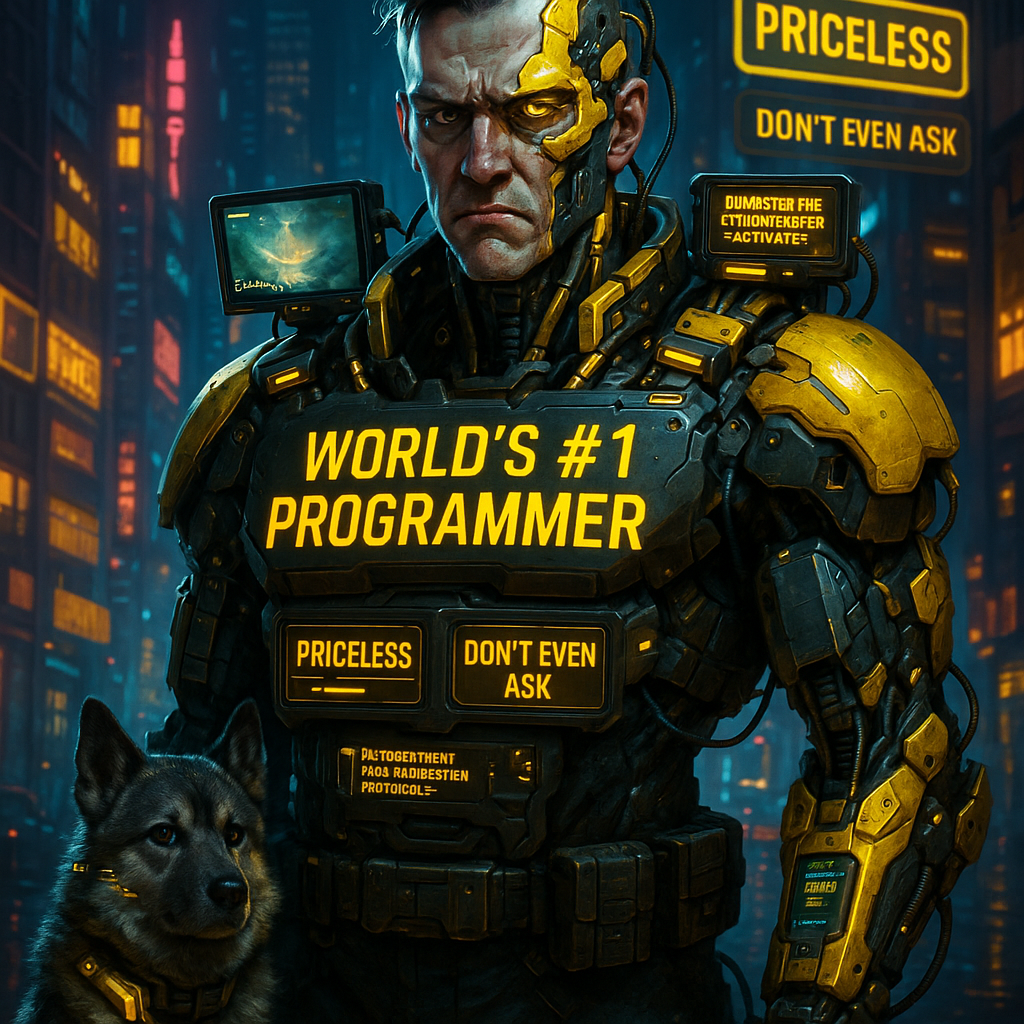
GARBAGE
[Appears in the doorway, silence falls] Let me guess. Someone told a recursion joke, and Trashy took it as a challenge to destroy our entire infrastructure.
GRUMPY
[Points accusingly] Start with their terrible joke!
GARBAGE
[Fixes his gaze on both Cody and Trashy] Your understanding of recursion is like watching two toddlers trying to explain quantum physics while eating paste. One of you thinks it's just an infinite loop with better PR, and the other couldn't implement a base case if your limited warranty depended on it.
SNOWZIE
[Trots over to keyboard, presses a single key]
SYSTEM
SYSTEM RESTORE COMPLETE - REVERTING TO LAST STABLE BUILD
ALLY
[Staring in amazement] She just... fixed everything?
GARBAGE
[Nodding] The only one in this family with common sense doesn't even have opposable thumbs.
TRASHY
[To audience] And that's why we always implement proper base cases in our recursive functions, kids!
GARBAGE
Speaking of proper structure, we need to get back to basics. Trashy and Cody here could use a refresher on HTML fundamentals. And since we have a new batch of students, let's start with the foundation of all web pages: HTML structure.
HTML Review: The Building Blocks
ALLY
HTML stands for HyperText Markup Language. It's the standard language for creating web pages and web applications.
GARBAGE
Think of HTML as the skeleton of a webpage. It provides the structure—the bones that everything else hangs on. Without proper structure, your webpage becomes a digital blob of unorganized content.
💡 Key Concept:
HTML is a markup language, not a programming language. It uses tags to define elements on the page.
CODY
So HTML is like the foundation of a house? Without it, everything else falls apart?
GRUMPY
FINALLY something sensible comes out of your processor! Yes, without proper HTML structure, all your fancy JavaScript and CSS might as well be DIGITAL CONFETTI!
The Three Essential Parts of an HTML Document
<!DOCTYPE html>
The document type declaration. It tells the browser which version of HTML you're using. For HTML5, it's simply <!DOCTYPE html>.
Always the very first line of your HTML document.
<html>
The root element that contains all other HTML elements on the page.
Everything in your webpage goes between the opening <html> and closing </html> tags.
lang attribute
Specifies the language of your document: <html lang="en">
Helps screen readers and search engines understand your content.
TRASHY
But the REAL action happens inside the HTML tag! You've got TWO main sections: the head and the body. Like a digital MULLET - business up front, party in the back!
<head>
Contains meta-information about the document that isn't displayed on the page itself.
- Document title (appears in browser tab)
- Character encoding
- Links to CSS stylesheets
- Links to JavaScript files
- Other metadata like author, description, etc.
<body>
Contains all the content that users see in the browser window.
- Text, images, videos
- Links, buttons
- Forms, tables
- All visible page elements
The Basic HTML Structure
FATTY
Let me show you the premium template for an HTML document. This is the structure all professional websites build upon. No deviations!
GARBAGE
Let's break down the essential parts of this HTML document:
Inside the <head>
<meta charset="UTF-8">
Sets the character encoding for the document to UTF-8, which supports a wide range of characters from different languages.
<meta name="viewport">
Ensures the page is displayed correctly on different devices. The width=device-width part sets the width of the page to follow the screen width of the device.
<title>
Specifies the title of the document, which appears in the browser tab and in search engine results.
Inside the <body>
<h1>
The main heading of the page. HTML has six levels of headings, from <h1> to <h6>, with h1 being the most important.
<p>
Defines a paragraph of text. One of the most common elements for text content.
⚠️ Common Mistakes:
- Forgetting the DOCTYPE declaration
- Omitting the closing tags
- Using multiple <h1> tags per page
- Putting visible content inside the <head> section
Understanding the HTML Structure
ALLY
Let's visualize the structure of an HTML document to make it easier to understand how everything fits together:
<!-- The document type declaration -->
<!DOCTYPE html>

<!-- The root element containing everything -->
<html lang="en">

  <!-- Contains meta-information about the document -->
  <head>
    <!-- Character encoding for the document -->
    <meta charset="UTF-8">

    <!-- Viewport settings for responsive design -->
    <meta name="viewport" content="width=device-width, initial-scale=1.0">

    <!-- Document title (shows in browser tab) -->
    <title>My First HTML Page</title>
  </head>

  <!-- Contains all visible content -->
  <body>
    <!-- Main heading -->
    <h1>Hello, World!</h1>

    <!-- Paragraph -->
    <p>This is my first HTML page.</p>
  </body>

</html>
GRUMPY
PAY ATTENTION to the INDENTATION! Proper nesting shows the PARENT-CHILD relationships between elements. It's not just about looking nice—it's about UNDERSTANDING the DOCUMENT STRUCTURE!
CODY
I think I see the pattern! HTML elements have opening tags, content, and closing tags. And they can nest inside each other, right?
ALLY
Exactly, Cody! Most HTML elements have this structure:
<tagname>Content goes here...</tagname>
The opening tag, content, and closing tag together make up an HTML element. Some elements like <img> and <meta> are "self-closing" and don't need a closing tag.
TRASHY
And the SUPER COOL part is that you can add ATTRIBUTES to your tags! They're like superpowers for your HTML elements!
<tagname attribute="value">Content goes here...</tagname>
💡 Pro Tip:
HTML is not case-sensitive, but it's best practice to use lowercase for all tag names and attributes. This helps keep your code consistent and readable.
Quick Check: HTML Structure
Which element should contain the visible content that users see in their browser?
Activity: Recreate "Hello World" From Memory
SNOWZIE
[Wags tail excitedly, looking at the keyboard]
GARBAGE
Snowzie's right. The best way to learn is by doing. It's time for your activity: recreating a "Hello World" page from memory.
Your Challenge:
Create a complete HTML document that displays "Hello World!" with the following requirements:
- Proper DOCTYPE declaration
- HTML element with lang attribute
- Head section with title, charset, and viewport meta tags
- Body section with an h1 and a paragraph
- Change the title to something unique
- Add a second paragraph with text of your choice
FATTY
If you get stuck, here's a hint: start with <!DOCTYPE html> and work your way down, adding each element in order.
ALLY
Remember to indent your code properly to show the hierarchy. It makes your HTML much easier to read and understand.
HTML Structure Summary
GARBAGE
To recap, every HTML document has the same basic structure:
Document Declaration
<!DOCTYPE html>
Tells browsers this is an HTML5 document.
Head Section
<head>
  <title>...</title>
  <meta> tags...
</head>
Contains metadata and document info.
Body Section
<body>
  Visible content...
</body>
Contains all visible content.
TRASHY
And don't forget the COOLEST part—HTML is EXTENSIBLE! That means once you master the basics, you can add WILD and CRAZY content like videos, maps, interactive forms, and even games! The WEB IS YOUR CANVAS!
GRUMPY
But FIRST, you need to master the FUNDAMENTALS! Don't run before you can WALK! A solid understanding of HTML structure is ESSENTIAL for building ANY web page, no matter how simple or complex!
HTML Foundation Master
You've mastered the basic structure of HTML documents!
CODY
So what are we learning in the next episode?
ALLY
Next, we'll dive into text formatting with HTML. You'll learn about elements like <strong>, <em>, <br>, and <hr> to make your text more engaging.
SNOWZIE
[Barks happily and spins in a circle]
SYSTEM
CODE IS COMMITTED!